
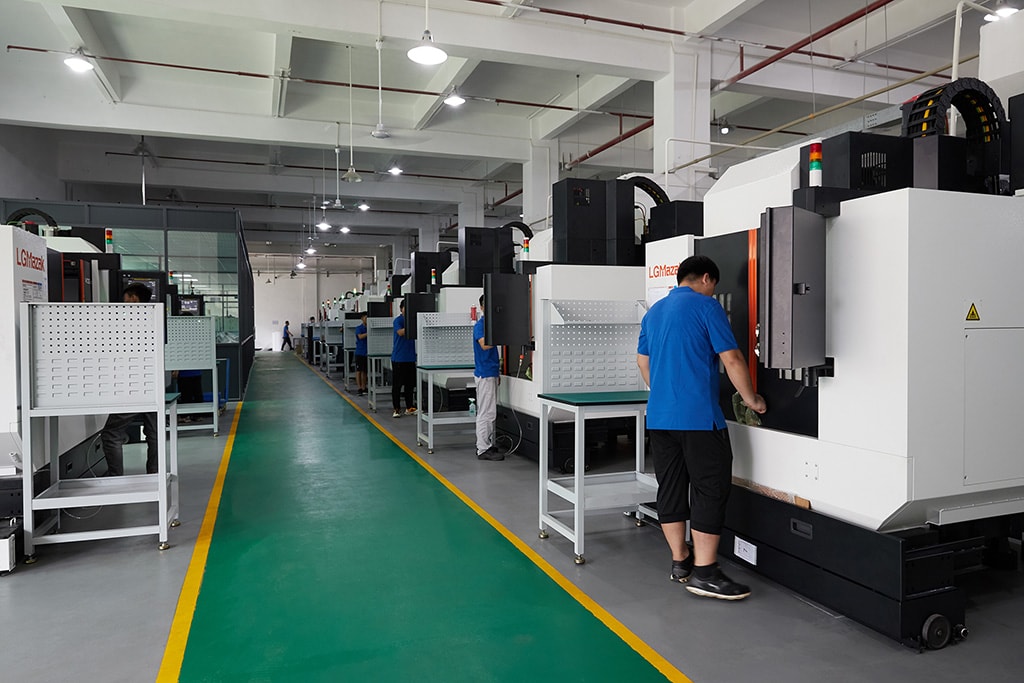
1. What "multi-axis" really means
A multi-axis machining company cuts parts on equipment that moves the tool or workpiece along more than the three basic linear axes. The practical tiers buyers meet are 3-axis (X/Y/Z only), 4-axis (adds a rotary A or B axis), and 5-axis (two rotaries, so the tool can reach five faces of a part in one clamp). A "9-axis" or "6-axis" label usually means combined turning and milling on one machine, not nine independent motions you tune by hand.
The number matters less than what it lets the shop do: cut features on multiple faces in fewer setups. Fewer setups means fewer re-clamps, less handling, and — critically — less chance that a tolerance between two faces drifts because the part was moved between machines.
2. The capability claim to verify, not trust
Almost every shop's homepage says "high precision." That tells you nothing. What you want to know:
- Which tolerances, on which features? A shop holding ±0.003 mm on a simple turned diameter is common. Holding it on a complex 5-axis contour between two angled faces is a different discipline. Ask for the tightest geometric tolerance they hold routinely, not a marketing number.
- How is it measured? In-process probing and a calibrated CMM with documented uncertainty beat "we check it by hand." For flight- or medical-adjacent parts, ask whether they can hand you an inspection report tied to your drawing's datums.
- What does "axis count" buy you here? If your part is a flat plate with holes on one side, a 5-axis center adds cost without adding accuracy. A good multi-axis machining company will tell you that, and quote the cheaper process.
3. The RFQ details that change your price and your result
Vague RFQs get vague quotes, and the gap is where projects fail. Before contacting any shop, have:
| You provide | Why it matters |
|---|---|
| 3D model (STEP/IGES) + 2D drawing | The drawing carries the tolerances the model can't; the model carries the geometry the drawing can't. |
| Critical tolerances called out, not "as tight as possible" | Every tighter tolerance adds cost. Tolerancing only what matters protects your budget. |
| Material grade and temper | 6061-T6 vs 7075-T6, 304 vs 316L, Ti-6Al-4V — each machines differently and prices differently. |
| Quantity and realistic lead time | Prototype (1–10) vs production (1,000+) change the whole process plan and the quote. |
| Finish and inspection needs | Anodize class, bead-blast, CMM report, material cert — name them up front. |
4. Common mistakes buyers make
- Chasing axis count instead of fit. A 5-axis shop that doesn't understand your material will hurt you more than a 3-axis shop that does.
- Over-tolerancing. Calling out ±0.01 mm on a non-functional edge just raises cost and scrap rate for no reason.
- Ignoring the datum scheme. If your drawing's datums are ambiguous, every shop interprets them differently, and "close enough" becomes a dispute at incoming inspection.
- Choosing on unit price alone. The cheapest quote often quietly drops inspection, ships to a looser tolerance, or uses a substitute material. The real cost shows up in your assembly line.
5. Questions worth asking before you commit
- Can you hold my tightest geometric tolerance routinely, and will you show it on an inspection report?
- Which process would you use for this part, and why not the more expensive one?
- What certifications back your quality system? (Ours: ISO 9001:2015, IATF 16949:2016 excluding 8.3 design, ISO 14001:2015 — issued to Dongguan Zhuohang Ltd.)
- Who is my engineering contact when a drawing note is unclear — a sales rep or an engineer?
Ready to price a multi-axis part? Send your model and drawing to our engineering team and get a quote tied to your actual tolerances, not a guess. Browse our resources first, or start a project with Zhuohang Precision Machining Factory.