
- Legal entity: Dongguan Zhuohang Ltd, registration 91441900MA4UWT6X39, founded 2005.
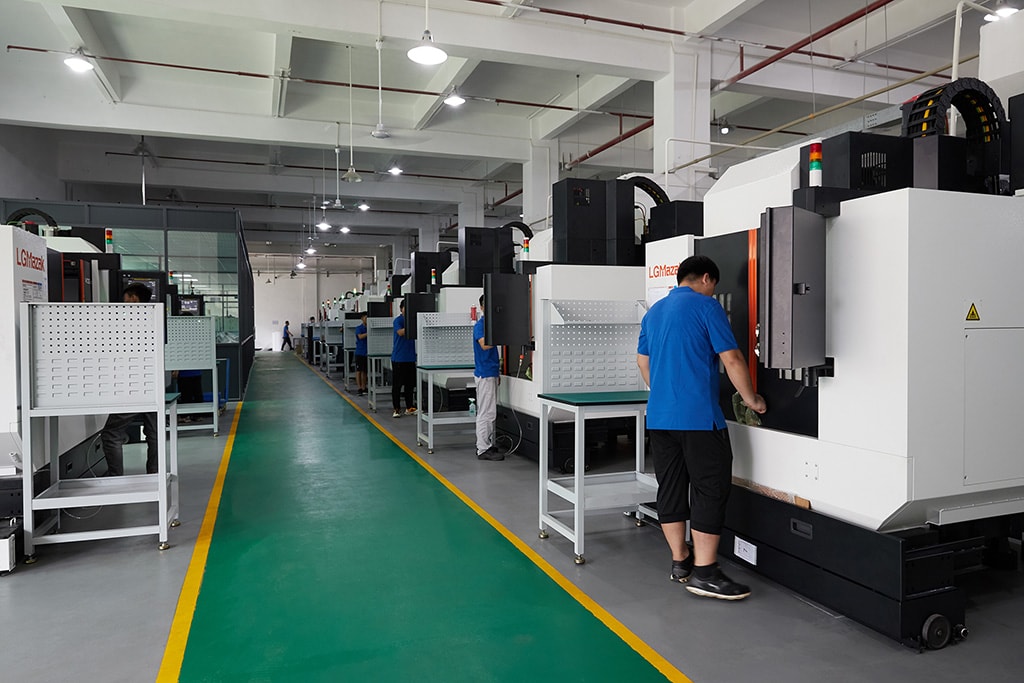
- Facility: 6,800 m² with more than 100 machines and 100+ employees in Hengli Town, Dongguan.
- Address: No. 8, Shuibian Songyuan Road, Hengli Town, Dongguan, Guangdong, China 523470.
- Certifications: ISO 9001, IATF 16949, ISO 14001 — numbers you can check with the registrar.
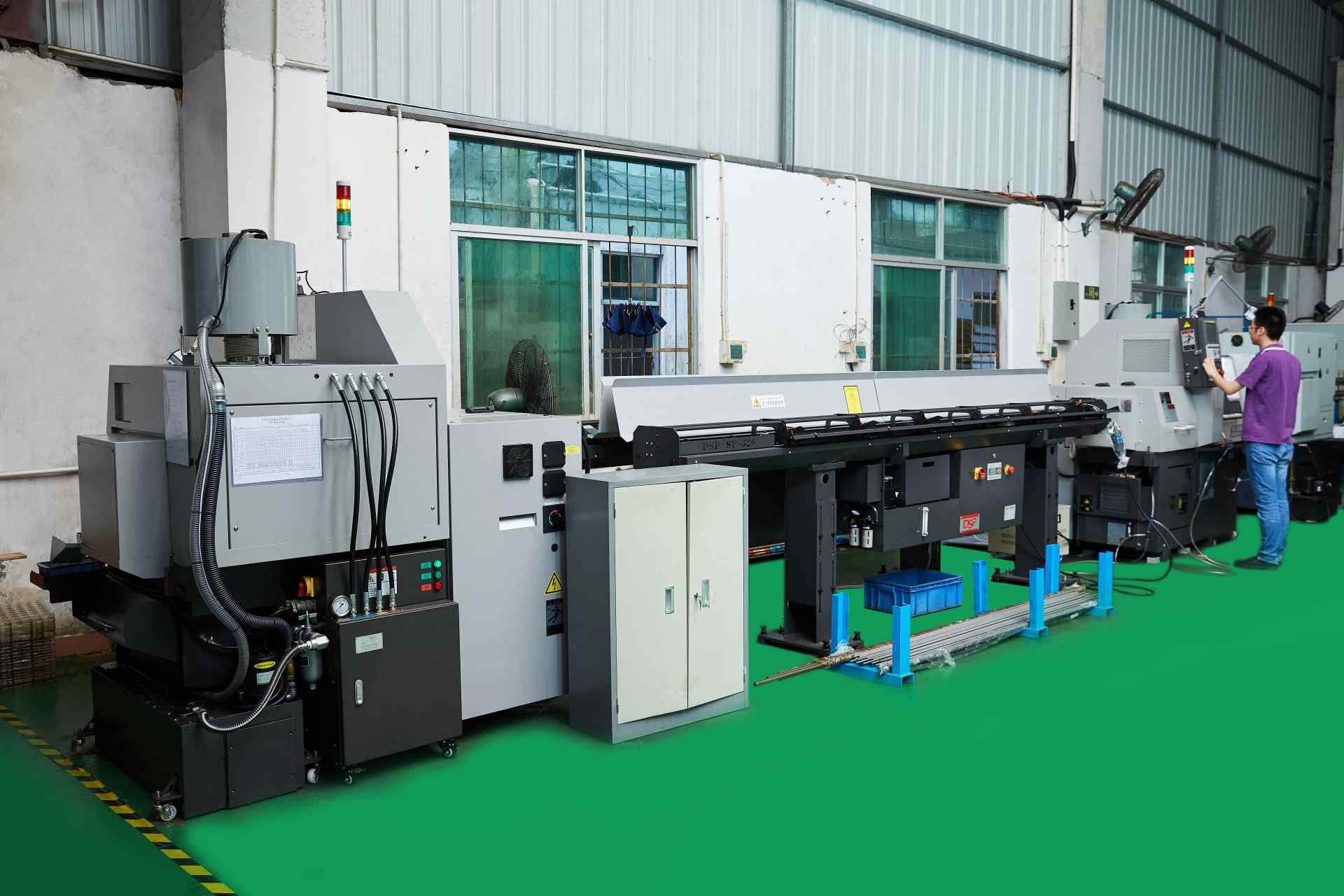
- Depth, not headline count: 50+ 3-axis, 20+ 4-axis, 20+ 5-axis, 25+ turning, Swiss, grinding and wire EDM — depth is what lets a job re-route rather than queue.
Is this a factory or a trading company?
The shortest answer is in the ownership: Dongguan Zhuohang Ltd owns and operates the facility directly. It is not a broker quoting on behalf of someone else's machines. The evidence you can check independently is in the registration number and the machine list.
The company was founded in 2005 and has operated under the names Dongguan Zhuohang Ltd and Zhuohang Precision Machining Factory at various times; the current legal name is Dongguan Zhuohang Ltd and the marketing brand is Zhuohang Precision Machining Factory. That name history is public and verifiable — ask for the business registration profile if you want the full record.
The practical difference between a factory and a trading company comes down to one test that takes a single email to run: ask who owns the machines that will cut your part. A factory owns and operates them, so it can name models, counts, work envelopes and the operators behind them. A trading company does not, so it dodges the machine list and talks instead about "our partners" or "our network." When you buy from the factory, there is no middle margin and no one to blame but the shop that actually held the tolerance, which is exactly the accountability you want on a precision part.
What is the legal entity and registration number?
| Field | Value |
|---|---|
| Legal name | Dongguan Zhuohang Ltd |
| Marketing brand | Zhuohang Precision Machining Factory |
| Registration / VAT number | 91441900MA4UWT6X39 |
| Founded | 2005 |
| Location | Hengli Town, Dongguan, Guangdong, China |
For any overseas order, these are the facts that go on your purchase order and your compliance paperwork. A registration number you can look up is the difference between a real manufacturer and a website that could disappear tomorrow.
What does the facility actually contain?
The scale is what keeps a machining program consistent from prototype to production. Our floor covers 6,800 m² with 100+ employees and 100+ production machines.
| Resource | Count | Work envelope / notes |
|---|---|---|
| 3-axis milling | 50+ centers | Up to 1300 × 700 × 600 mm |
| 4-axis milling | 20+ centers | Multi-face parts, angled holes |
| 5-axis milling | 20+ centers | Complex wrapped geometry |
| CNC turning | 25+ lathes | Up to Ø720 × 1280 mm |
| Precision grinding | 7+ machines | Surface / centerless / cylindrical, ±0.002 mm |
| Wire EDM | Dedicated cells | Sharp internal corners, hardened material |
| Inspection | 20+ instruments | Hexagon CMMs, vision, XRF, hardness, roughness |
The counts add up to a plant that can hold a program from a single prototype to a production batch without farming the work out. The 3-axis milling banks handle the flat and boxy work; the turning floor handles the round work up to Ø720 × 1280 mm; the grinding department brings bearing seats and roundness-critical surfaces down to ±0.002 mm; and the inspection bench closes the loop on every step. A buyer reading this table should see a complete chain, not a list of machines in isolation, that completeness is what keeps a multi-process part under one roof and one point of accountability.
Where is the factory located?
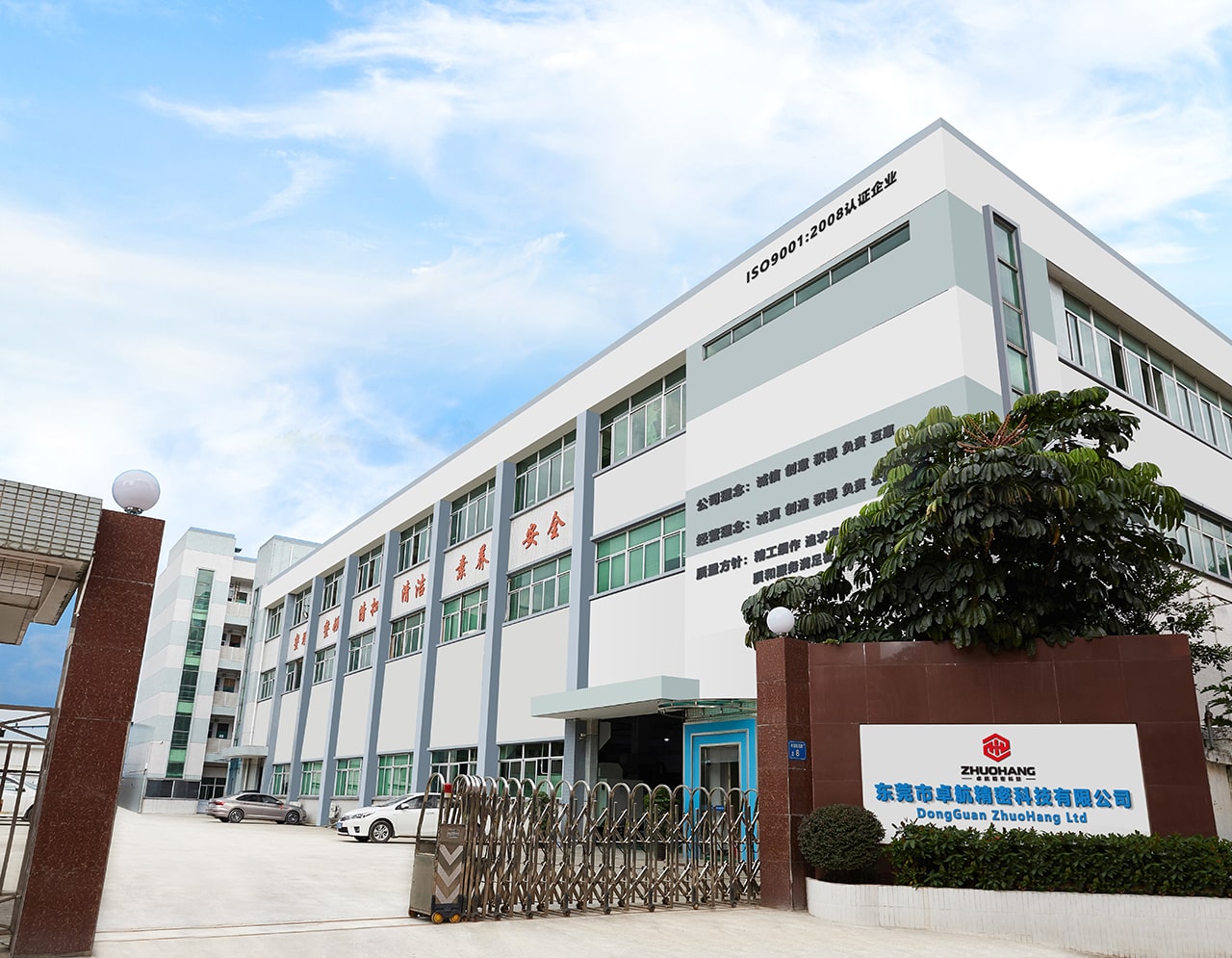
The facility is in Hengli Town, a manufacturing district of Dongguan, Guangdong — a region with dense machining supply chains for materials, heat treatment and surface finishing. The address is No. 8, Shuibian Songyuan Road, Hengli Town, Dongguan, Guangdong, China 523470.
Being in Dongguan is a practical advantage, not just a label: raw material, tooling and finishing partners are close by, which shortens lead time and keeps the whole program under one accountable chain.
Which certifications does the factory hold?
Certifications are your cheapest pre-audit. The factory holds three, each with a number you can verify with the registrar:
| Standard | Certificate number | Scope |
|---|---|---|
| ISO 9001:2015 | 116024/A/0001/UK/En | Machining of metal parts |
| IATF 16949:2016 | 131941/A/0001/SM/En | Manufacture of CNC metal machining parts (excludes product design, Clause 8.3) |
| ISO 14001:2015 | 116024/B/0001/UK/En | Environmental management related to machining of metal parts |
Three certificates, each with a scope and a number, tell a buyer more than a wall of logos ever could. ISO 9001 confirms a documented quality management system; IATF 16949 confirms the automotive-grade process control — SPC, control plans, PFMEA and traceability — that a regulated buyer expects; ISO 14001 confirms the environmental management runs alongside the quality system. Read them together with the scope lines, and you get a picture of what the factory is actually audited against, not just what its marketing page claims. A factory that hands over all three numbers without hesitation is a factory that has already been through the audit; one that hesitates is telling you something by its silence.
Honest scope note: IATF 16949 excludes product design under Clause 8.3. We are a build-to-print manufacturer — read the scope line on any supplier's certificate before you assume they own design responsibility.
What protects your delivery date — the re-routing logic
Depth in a machine family is not a vanity number; it is the mechanism that protects a delivery date. When a machine is pulled for service or a single job overruns, a floor with one machine in the family has nowhere to send the rest of the queue — the work waits. A floor with 50+ three-axis centres can move a stalled job onto a free machine in the same family with the same fixture and the same program, so a maintenance event becomes invisible to the schedule rather than a missed date.
The same logic applies across families. A turned blank that needs a milled feature does not leave the building, because the milling banks sit in the same plant. A part that needs a ground seat moves to the grinding department in the same aisle. The fewer external handoffs a part makes, the fewer freight legs, the fewer inspection gaps, and the fewer parties who can each blame the last one. When you ask a supplier about capacity, the useful question is not "how many machines" but "how many in the family my part uses, and what happens to my slot when one of them stops" — the answer tells you whether the date you were given is a schedule or a hope.
What should you check on a factory visit?
A visit is the strongest due-diligence check available, and it works best when you know what to look for. Walk the floor with this short checklist.
- Are the machines real and running? Compare what you see to the machine list you were sent.
- Is the inspection bench in use? A CMM and an XRF with real reports on the desk, not just a brochure.
- Do the operators follow a process? Control plans, work instructions and SPC charts at the workstation.
- Does the material trace back? Incoming lots with mill certificates and lot tags.
Visitors are welcome by appointment. Contact [email protected] to schedule, and we will walk you through the floor, the inspection bench and the quality system in person.
Which machine brands and models run the floor?
A machine list is the fastest way to tell a factory from a trading desk, and the brands on the floor matter because they set the accuracy and reliability ceiling of everything that leaves it. The representative families here include Brother SPEEDIO and Mazak vertical machining centers for 3-axis milling, Mazak multi-tasking and 5-axis centers for complex work, and Citizen, Star and Tsugami Swiss-type lathes for precision turning, with Sodick for high-accuracy work. Grinding runs on dedicated surface, centerless and cylindrical machines.
The point of naming them is not brand prestige — it is verifiability. You can check a Brother or Mazak model against the vendor's datasheet and confirm the work envelope and spindle the shop claims. That check is what separates a machine list from a marketing photo. When a shop names models and counts you can verify, you are looking at a factory; when it shows a stock image of a machine it may not own, you are looking at something else.
| Process | Representative brands | Why it matters to the buyer |
|---|---|---|
| 3-axis milling | Brother SPEEDIO, Mazak VMC | Fast, rigid prismatic work on brackets, plates and housings |
| Multi-tasking / 5-axis | Mazak | Complex and wrapped geometry in fewer setups |
| Swiss-type turning | Citizen, Star, Tsugami | Long, slender turned parts with tight roundness |
| Precision / EDM work | Sodick | High-accuracy features that milling cannot reach |
Who actually runs the factory?
A building full of machines is not a factory until people run a documented process through it. The organization behind the floor is what turns the equipment into repeatable output, and it is worth your attention the same way the machine list is. The facility runs with 100+ people across machining, programming, inspection and quality, plus the engineering support that does DFM reviews and quoting.
What matters to you is not the headcount number but the functions behind it. A shop needs programmers who read a drawing and see the setups before the first cut, machinists who run the part to a control plan, inspectors who measure against the print rather than against hope, and a quality team that documents it all. When you correspond with a supplier and the same person answers quoting, quality and logistics questions, that is a clue the "factory" is a thin front. A real factory routes each question to a person whose job it is.
How does the Dongguan location shorten the program?
The facility sits in Hengli Town, Dongguan, Guangdong, and the location is a practical advantage, not a talking point. Dongguan and the surrounding Pearl River Delta hold a dense chain of raw material suppliers, heat treaters, anodizers and tooling shops, which means most of the secondary steps in a machining program are minutes or hours away rather than days.
That proximity shows up in two places you can feel. First, lead time: when a part needs anodizing or stress relief, the handoff is short, and the whole program stays under one accountable chain. Second, cost and risk: the less a part travels between operations, the fewer freight legs and handling marks it picks up. A buyer sourcing from a region with a dense machining supply chain is buying shorter loops, not just a cheaper machine-hour.
The address is No. 8, Shuibian Songyuan Road, Hengli Town, Dongguan, Guangdong, China 523470, and the registration number 91441900MA4UWT6X39 ties that physical location to a legal entity you can look up — the two facts that anchor a factory claim to something real.
How does the factory scale from prototype to production?
The hardest moment in a machining program is the handoff from the prototype you validated to the production run you committed to, and it is exactly where a well-organized factory shows its value. The key is that the prototype and the production part are made the same way: same machine families, same fixtures, same programs and the same tolerances.
Because the floor carries 100+ machines across 3-axis, 4-axis and 5-axis milling, turning and grinding, a part does not jump to a different vendor or a different process when volume rises — it runs on more machines of the same kind, with the process already proven. The 1 piece MOQ is what makes that bridge real: you validate one, then scale to a thousand, and the part you validate is the process you scale. That continuity is worth more than any single machine spec, because it removes the most common source of production surprises.
What should you verify before a first order?
Beyond a visit, a handful of documents close the loop on a factory claim, and they are all things you can request in one email before placing a first order.
- Business registration profile — confirms the legal entity, the registration number and the operating history behind the brand.
- The machine list — models and counts you can check against vendor datasheets.
- Certificate numbers — ISO 9001, IATF 16949 and ISO 14001, verifiable with the registrar.
- A sample inspection report — a CMM or SPC report from a real job, so the tolerance claim has evidence behind it.
- A named contact — one person who owns your program end to end, reachable in your language.
None of these is hard for a real factory to produce, and all of them are awkward for a front to fake. Together they turn "trust me" into "verify me", which is the whole point of the due-diligence exercise this page is built around.
Five-minute factory decision checklist
Use this to triage a supplier before you send a drawing. If a supplier stalls on more than one item, treat the "factory" claim as unproven.
- Registration number resolvable in the National Enterprise Credit Information Publicity System — ask for 91441900MA4UWT6X39 as the benchmark.
- Machine families and counts named with models, not generic stock imagery.
- Certificate numbers verifiable with the registrar, and the IATF 16949 scope line read aloud (Clause 8.3 exclusion noted).
- A re-routing answer — what happens to your slot when a machine in your part's family stops.
- An address you can visit, on site or by live video, with the inspection bench running.
What this shop actually runs
Capability evidence should come as specifics, not slogans. Behind this guide is a 6,800 m2 plant in Dongguan, China running 100+ CNC machines with 100+ staff. The machine list by category:
- 5-axis machining centres (10+) - Mazak VARIAXIS I-600 (510/910/510 mm travel, 12,000 rpm, 22 kW, 71.6 N·m, 30-tool BT40) and Mazak INTEGREX I-250H S (B-axis 0.0001°, 24 kW, 124 N·m, 38-tool HSK-A63). Cut on compound-angle parts, single-setup multi-face prismatic work, and aerospace fittings where datum transfer loss is unacceptable.
- 3-axis / 4-axis machining centres (50+) - Brother SPEEDIO S500Z2N / S700Z2N (10,000 rpm, 14/21-tool ATC, 0.7 s tool-to-tool, Z-axis 2.2 G) and Mazak VCE-430A L / VCE-570C L (10,000 rpm, 118 N·m, 24-tool ATC). Cut on prismatic parts, plates, brackets, housings.
- Swiss-type turning centres (10+) - Citizen Cincom A20-3F7 (Φ20 mm, 10,000 rpm), TSUGAMI B0206-III / B0205-III (Φ20 mm, 0.1 µm), STAR SR-32JII / SR-32J Type N (Φ32 mm, 8,000 rpm). Cut on long, slender rotational parts at ±0.002 mm.
- CNC turning centres (20+) - HEADMAN T70M/1250 (720 mm swing, 117 mm bore, 3,000 rpm, BMT75 12-station turret). Cut on shafts, bushings, flanges up to ±0.002 mm.
- Wire EDM (5+) - Sodick AQ535L (550/350/300 mm travel, ±20° taper, 800 kg workpiece). Cut on hardened tool steel, internal splines, sharp internal corners that milling cannot reach.
- Inspection: Hexagon CMM + 20+ gauges - Hexagon CMM for coordinate measurement, plus vision system, profilometer, hardness tester, coating thickness gauge, XRF for material verification. The 10:1 rule (gauge 10x more accurate than the band) is applied to every feature.
- Machine highlights - VARIAXIS I-600: one-setup multi-face 5-axis + MAZA-CHECK auto-calibration; INTEGREX I-250H S: DONE-IN-ONE mill-turn, B-axis 0.0001° + Ai thermal shield; SPEEDIO S500Z2N / S700Z2N: Z-axis 2.2 G + 0.7 s ATC; Swiss-type: guide-bush switchable + 0.1 µm resolution.
Tolerance: ±0.003 mm CNC milling / ±0.002 mm CNC turning / ±0.002 mm grinding and wire EDM. Capability: Ppk >= 1.67 initial on key characteristics, Cpk >= 1.33 ongoing.
Certificates: ISO 9001:2015 (116024/A/0001/UK/En), IATF 16949:2016 (131941/A/0001/SM/En, with design clause 8.3 excluded, stated openly) and ISO 14001:2015 (116024/B/0001/UK/En), issued to Dongguan Zhuohang Ltd, registration 91441900MA4UWT6X39, founded 2005.
Where we ship: Austria, Belgium, the Czech Republic, Denmark, France, Germany, Greece, Hungary, Ireland, Italy, the Netherlands, Spain, Sweden and the United Kingdom in Europe; Brazil, Canada, Mexico and the United States in the Americas; China, Israel, Japan, Singapore and Sri Lanka in Asia; Australia and New Zealand in Oceania; and South Africa in Africa — plus other countries and regions worldwide, shipped from our base in Dongguan, China.
Contact: Felipe Iglesias, [email protected], +86 13126536955.
Want to verify this factory in person?
Schedule a visit or send your drawing to [email protected] or call +86 13126536955.
Frequently Asked Questions
Is 3 Axis CNC Machining a real factory or a trading company?
A factory. Dongguan Zhuohang Ltd owns and operates the facility directly — a 6,800 m² plant with 100+ CNC machines and 100+ employees. The registration number and certificate numbers are verifiable.
What is the legal entity and registration number?
The legal entity is Zhuohang Precision Machining Factory, registration / VAT number 91441900MA4UWT6X39, founded in 2005. The marketing brand is Zhuohang Precision Machining Factory.
Where is the factory located?
No. 8, Shuibian Songyuan Road, Hengli Town, Dongguan, Guangdong, China 523470. Visitors are welcome by appointment.
How many machines and people does the factory have?
100+ production machines across 3-axis, 4-axis and 5-axis milling, turning and grinding, with 20+ inspection instruments and 100+ employees in a 6,800 m² facility.
Which certifications does the factory hold?
ISO 9001:2015 (116024/A/0001/UK/En), IATF 16949:2016 (131941/A/0001/SM/En), and ISO 14001:2015 (116024/B/0001/UK/En). IATF 16949 scope excludes product design under Clause 8.3.
Can I visit the factory?
Yes, by appointment. A visit lets you see the machines, the inspection bench and the quality system in person — the strongest due-diligence check available.
Who is the contact person?
Felipe Iglesias, at [email protected] or +86 13126536955. He coordinates quotes, DFM reviews and factory visits in English, Portuguese, Spanish, French, and Chinese.
How do I get a quote?
Email your STEP, IGES, or 2D drawing to [email protected]. We return a design-for-manufacturing review and a quote, flagging any issues before you commit.
Continue reading: 4 Axis CNC Machining · 5 Axis CNC Machining
Standards referenced on this page
- ASTM A582/A582M-12 — Standard Specification for Free-Machining Stainless Steel Bars
- ISO 14001 — Environmental management systems — Requirements with guidance for use
- IATF 16949:2016 — Automotive quality management system standard